Warning Signs
Foundation Heaving (vs. Settling)
The short answer
Foundation heave is the foundation lifting upward — the opposite of settlement — when expansive clay beneath it swells with moisture. Common causes are plumbing leaks, poor drainage, or clay rehydrating after drought. Signs include a dome-shaped (high-in-the-middle) floor, cracks wider at the top, and doors binding at the top of the frame.
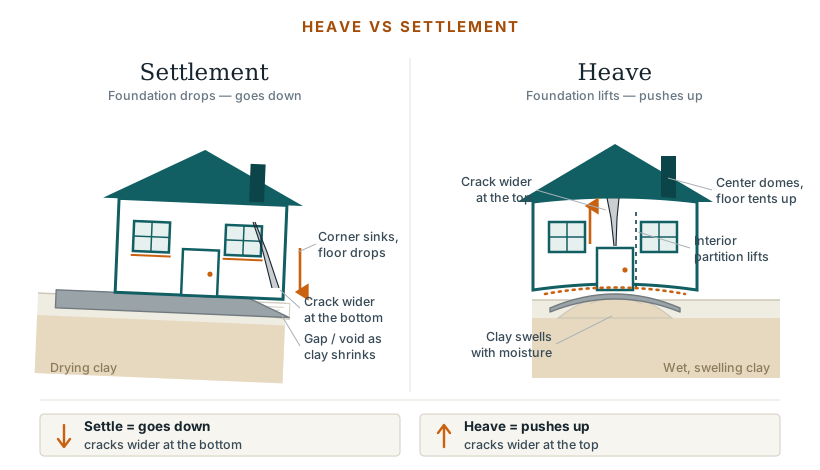

Heave is settlement’s opposite
Most people picture foundations sinking. But on expansive clay, the reverse is just as common: heave, where the clay swells with moisture and pushes the foundation up. Because heave and settlement leave similar cracks, they’re easy to confuse — and treating one as the other wastes money. Getting the diagnosis right is everything.
Telling heave from settlement
| Clue | Heave (lifting) | Settlement (sinking) |
|---|---|---|
| Floor shape | High in the middle (dome) | Low in one area (dip) |
| Crack width | Often wider at the top | Often wider at the bottom |
| Doors sticking | Bind at the top of the frame | Drag at the bottom / won’t latch |
| Common trigger | Water/leak, post-drought swelling | Drought, drying clay, washout |
What causes heave here
It’s a water story. The clay under part of the slab gets wetter than the rest and swells: a plumbing leak, poor drainage funneling water under the slab, over-watering one side, or — very common in Austin — clay rehydrating after a drought and expanding. Find and fix the water source first.
There’s a fifth, counterintuitive trigger: removing a large, thirsty tree near the slab. A mature oak or elm can spend years pulling moisture out of the clay near your house; cut it down and the roots stop drinking, so the clay slowly reabsorbs all the water they used to take and swells as it rehydrates — heaving the foundation it had actually been helping keep settled toward. See how tree roots interact with Austin clay for the full mechanism before you plan any tree removal near a foundation.
How it’s diagnosed and fixed
A measured elevation survey maps whether the slab is domed (heave) or dished (settlement). Heave repairs focus on removing the excess moisture — fixing leaks and drainage — and sometimes relieving the swollen area; settlement repairs add piers to lift and support. Same-looking cracks, very different fixes.
How much does foundation heave repair cost?
Heave repair cost tracks the water source, not pier count — most heave cases never need piers at all. Three common paths, cheapest to most involved:
- A plumbing leak: detection runs $300–$800, with the repair itself $500–$4,000+ depending on access. See foundation leak repair costs.
- Poor drainage: grading and downspout fixes can be a few hundred dollars; a full French-drain system runs $2,000–$10,000. See the waterproofing cost breakdown.
- Releveling the slab, only if the swelling left lasting deformation once the water is controlled: $4,000–$15,000. See house leveling costs.
Most heave resolves with the first two once the water source is gone — releveling is the exception, not the rule.
Seeing signs of heave? Get a vetted inspection before anyone sells you piers you may not need.
Frequently asked questions
What's the difference between heaving and settling?
Settling is the foundation sinking (clay drying and shrinking, often in drought). Heaving is the foundation lifting (clay absorbing water and swelling). They produce similar-looking cracks but are opposite problems — which is exactly why a correct diagnosis is essential before any repair.
How do I know if my foundation is heaving?
Tell-tale signs: floors that are high in the center (a dome rather than a dip), cracks that are wider at the top than the bottom, interior doors binding at the top of the frame, and a slab that's risen relative to a porch or driveway. A manometer survey confirms it by mapping the high and low points.
What causes a foundation to heave in Austin?
Water reaching the clay under the slab: a plumbing leak, poor drainage concentrating runoff, over-watering one side, or — very commonly here — clay rehydrating and swelling after a long drought. The fix starts with finding and stopping the water source.
How much does it cost to fix foundation heave?
It depends on the water source, not on piers — heave rarely needs them. A plumbing leak runs $300–$800 to detect plus $500–$4,000+ to repair; drainage correction runs a few hundred dollars for grading up to $2,000–$10,000 for a full French-drain system. Releveling the slab afterward, if the heave left lasting deformation, adds $4,000–$15,000.
Can removing a tree cause foundation heave?
Yes — it's a common, counterintuitive trigger. A large tree can spend years pulling moisture out of nearby clay; once it's removed, the roots stop drinking and the clay slowly reabsorbs that water, swelling as it rehydrates. That can heave the foundation over the following seasons, sometimes worse than the settlement the tree was masking. Treat removing a big tree near a slab as a decision to make with an engineer, not a landscaping call.