The two foundations you’ll see in Austin
Nearly every home in the Austin metro sits on one of two foundation types, and knowing which you have is the first step to understanding any movement, repair quote, or inspection report. Both face the same enemy here — expansive clay soil — but they carry the house over it in completely different ways, so they fail and get repaired differently.
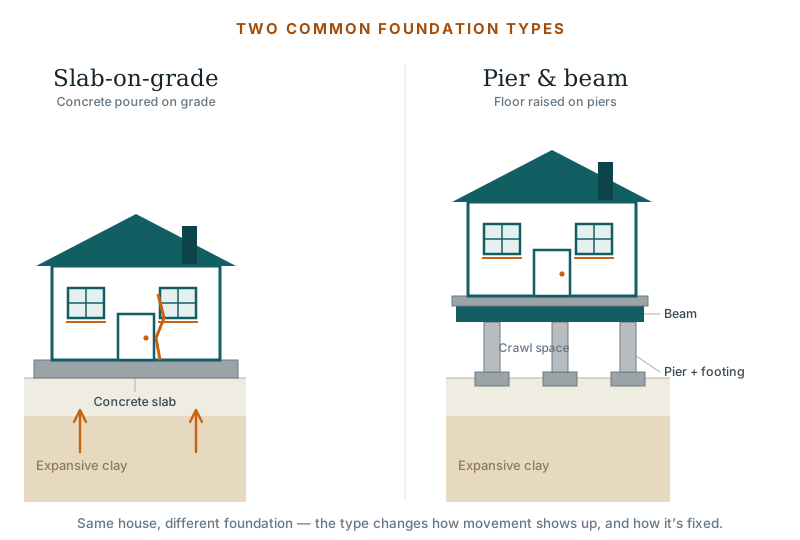
- Slab-on-grade — the house is poured on a single concrete slab resting directly on the soil. When the clay swells or shrinks, the slab moves with it. Standard on Austin homes built since the mid-1980s.
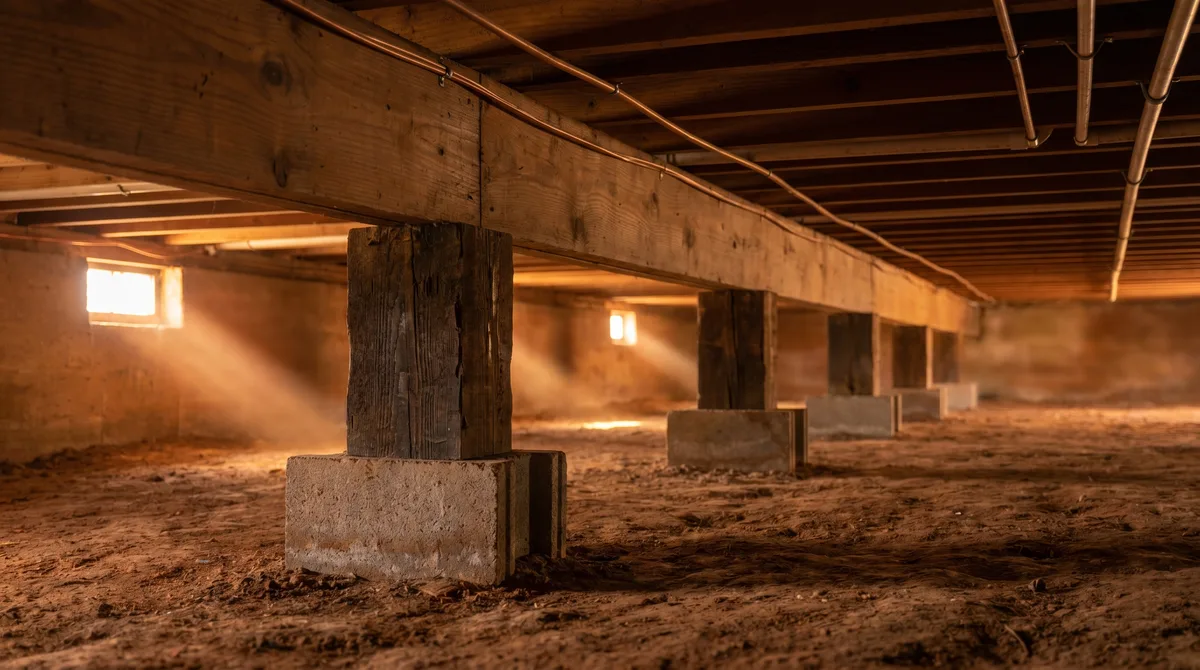
- Pier and beam — the house sits on piers and wooden beams above a crawl space. The gap decouples the structure from the worst of the soil’s movement. Common in older Central, South, and East Austin homes.
How to tell which foundation you have
You can usually identify your foundation in under a minute without any tools. If there’s a crawl space — a vent or access hatch around the base of the house, floors that sound hollow or have a slight bounce, or visible piers and beams underneath — you have pier and beam. If the floors sit directly on concrete with no crawl space and the home was built after roughly the mid-1980s, it’s almost certainly slab-on-grade. When you’re still unsure, the home’s age and your county appraisal-district record (which often lists foundation type) settle it.
Slab vs. pier and beam at a glance
For most Austin homeowners the practical differences come down to how each behaves on clay, how it’s repaired, and what it costs. Here’s the short version — see the full pier and beam vs. slab comparison for the detail.
| Factor | Slab-on-grade | Pier & beam |
|---|
| Behavior on clay | Rides soil movement directly | Crawl space buffers movement; more gradual |
| How it’s repaired | Underpinning piers (excavate/drill) | Shim, add piers, re-level from crawl space |
| Typical repair cost | $4,000–$12,000 | $5,000–$15,000 (lower per comparable job) |
| Common in | Newer Austin homes (post-1980s) | Older Central/South/East Austin homes |
| Watch for | Plumbing leaks under the slab | Crawl-space moisture, wood rot |
Cost ranges are Central Texas re-leveling figures; a single settled corner can run $2,500–$4,000. See the cost guide for what drives your number.
How each foundation fails on Central Texas clay
East of I-35, Austin sits on Blackland Prairie clay with high shrink-swell potential — it expands when wet and contracts in drought, moving several inches a year. A slab telegraphs that movement straight into the structure: you see diagonal cracks, sticking doors and windows, and uneven or sloping floors as one part of the slab lifts or drops relative to another. A pier and beam home shows movement more slowly — a bouncy or sagging floor, gaps at trim, or doors that drift out of square — because the beams flex and individual piers can settle. Either way, the warning signs of foundation problems are worth catching early, and the strongest prevention for both is steady moisture management around the perimeter.
Why don’t Austin homes have basements?
Slab-on-grade and pier and beam aren’t the only foundation types that exist — they’re the only two that make engineering sense here. Most of the country builds basements; Central Texas almost never does, for two concrete reasons. First, expansive Blackland clay doesn’t stop pushing at grade — the same swelling that heaves a slab or shifts a pier presses laterally against anything buried below it, and a basement wall has to resist that push year after year without the flex a shallower foundation has. Second, basements exist in northern states largely because builders already have to dig below the frost line to keep footings from heaving in freezing ground; under IRC §R403.1.4, footings need only 12 inches of cover here, since Central Texas has little to no frost line to dig past, so there’s no “already excavated that deep” reason to add a basement. Add a locally variable water table in low-lying spots and the waterproofing and drainage a basement would need get expensive fast. A handful of custom Austin homes do have engineered basements — reinforced walls, active drainage, a structural engineer sign-off — but for the typical home, slab-on-grade or pier and beam is what you’ll find, and what this site covers. It’s also why exterior membrane foundation waterproofing is rare here — without a basement wall buried below grade, there’s little to seal; grading, gutters, and French drains do the real work instead.
Pick your foundation type for the full breakdown of how it behaves on Central Texas clay and what repairs typically involve.