Austin foundations fail mainly because of expansive clay soil. East of I-35, the Blackland Prairie's smectite-rich Vertisols — soils like Houston Black and Branyon — swell when wet and shrink in drought, moving several inches seasonally. That cyclical movement, amplified by Central Texas's drought-to-flood swings, is what cracks slabs and distorts pier-and-beam homes.
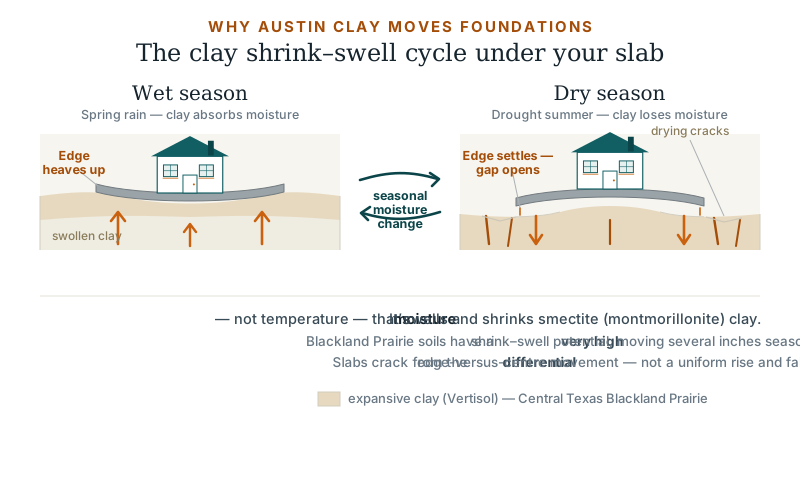
The seasonal shrink–swell cycle of Austin's expansive clay: wet clay swells and heaves the slab edge; dry clay shrinks and the perimeter settles.
By Austin Archuleta, Founder, TrueLevel B.S. Civil Engineering — Cockrell School of Engineering, The University of Texas at AustinReviewed & updated September 8, 2026
The single most important thing to understand about Austin foundations is that the problem is almost always the ground, not the construction. Central Texas sits on some of the most active expansive clay in the United States, and that clay — not poor building — is what moves foundations here.
The clay: smectite Vertisols
The dark, sticky soils of the Blackland Prairie east of I-35 are classified by the USDA as Vertisols — the soil order defined by shrink-swell cracking. Austin’s signature soils (Houston Black, Branyon, Heiden) are all “fine, smectitic, thermic Haplusterts.” That word smectitic is the whole story: smectite (montmorillonite) clay swells dramatically when it absorbs water and shrinks as it dries.
How much? The USDA measures shrink-swell as Linear Extensibility (LEP): soils rated 6–9% are “High” and above 9% “Very High.” Blackland Prairie clays sit comfortably in that very-high range. Per USDA’s official soil interpretation, once LEP passes 3%, “shrinking and swelling can cause damage to buildings, roads, and other structures” and special design is commonly needed.
The Balcones Fault: a tale of two soils
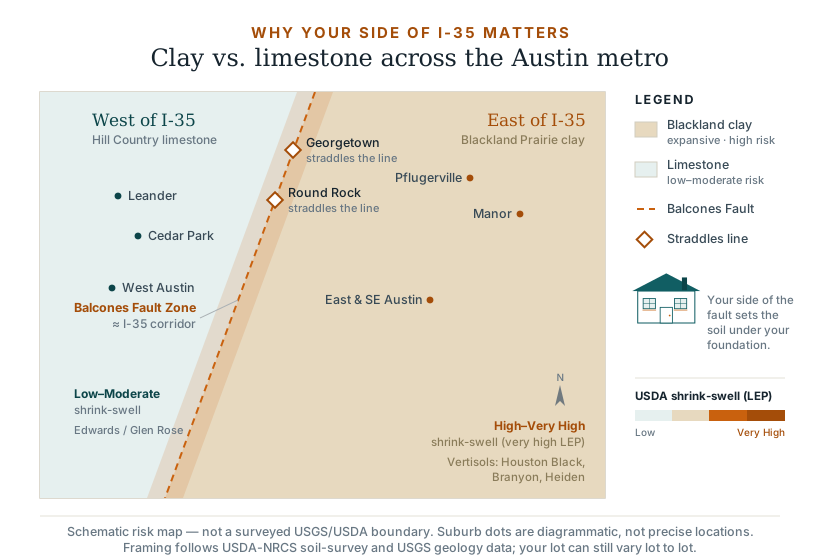
Austin straddles the Balcones Fault Zone, a band of faults running roughly along I-35 that drops the eastern side hundreds of feet. That single geologic line divides the metro:
East of I-35 (Blackland Prairie): deep expansive clay over the Taylor Group and Eagle Ford formations — high to very high foundation risk. (Pflugerville, East/Southeast Austin, Manor, much of Round Rock’s east side.)
West of I-35 (Hill Country): thin, rocky soils over Edwards and Glen Rose limestone — low to moderate risk. (Cedar Park, Leander, West Austin.)
Why your side of I-35 matters: the Balcones Fault splits Austin into east-side expansive clay and west-side limestone — a schematic risk map, not a surveyed boundary.
This is why two homes ten miles apart can have completely different foundation fates. See exactly where your area falls on our soil risk by neighborhood map.
Edwards Plateau soil: why the Hill Country side moves less
West of the Balcones Fault, Austin’s Hill Country sits on the Edwards Plateau — a limestone tableland where the soils are thin, stony, and rarely more than a foot or two deep over Edwards and Glen Rose bedrock. Series like Tarrant, Brackett, and Speck are shallow Mollisols, so even where their clay fraction can shrink and swell, there simply isn’t enough soil depth to heave a foundation the way deep Blackland clay does.
The practical difference is bearing: a slab on the Edwards Plateau usually rests on or just above competent limestone, which barely moves with moisture, whereas a Blackland slab floats on several feet of clay that gains and loses inches of volume each year. That’s why suburbs like Cedar Park, Leander, Lakeway, and Dripping Springs carry low-to-moderate foundation risk while the Blackland suburbs east of I-35 sit in the high-to-very-high range.
Edwards Plateau soil is not risk-free, though. Shallow soil over rock has its own quirks — pockets of deeper transported clay collect in valleys and low spots, drainage off rock can be flashy, and homes that straddle the fault zone (Round Rock, Georgetown, central Austin) can have clay on one side of the lot and limestone on the other. Risk on the Plateau is genuinely address-specific, which is why our neighborhood soil map maps each suburb to its actual soil series.
What foundation problems does clay soil cause?
When expansive clay swings between swollen and shrunken, it doesn’t move a home evenly — one corner lifts while another drops. That differential movement is what shows up inside the house. The most common clay-soil foundation problems in Austin are:
Separation at the exterior — gaps where brick meets trim, or a chimney pulling away from the wall.
These aren’t random construction defects; they’re the predictable result of a foundation riding clay that gains and loses several inches of volume with the seasons. The same house on Hill Country limestone would rarely show them.
The trigger: Central Texas’s drought-flood cycle
Expansive clay only causes trouble when its moisture changes. Central Texas is built for that: long droughts that bake and shrink the clay, broken by heavy rains that swell it back up. Each cycle moves the soil — and the foundation on it — a little more. A historic drought followed by a wet spring is the classic recipe for a sudden rash of foundation cracks across the city.
What this means for you
You can’t change the geology, but you can control the one thing that drives the damage: soil moisture. Keeping it steady — through drainage and grading, gutters, root barriers, and consistent foundation watering in summer — is the cheapest, most effective foundation insurance in Austin. And if you’re already seeing warning signs, the movement is telling you the moisture balance has already been lost — at that point, house leveling in Austin restores the elevation while drainage keeps the clay from moving it again.
Frequently asked questions
What kind of soil does Austin have?
It depends which side of the Balcones Fault (roughly I-35) you're on. East of the fault is the Blackland Prairie — deep, dark, expansive clay soils classified as Vertisols (Houston Black, Branyon, Heiden). West of the fault is the Hill Country, with thin, rocky soils over Edwards and Glen Rose limestone. The clay east side is where most foundation problems happen.
Why is expansive clay so bad for foundations?
Expansive clay is rich in smectite (montmorillonite), a mineral that absorbs water and swells, then shrinks as it dries. In Central Texas that means the ground under your home lifts in wet weather and drops in drought — often unevenly. Foundations aren't designed to ride that constant, differential movement, so they crack.
How much does Austin clay actually move?
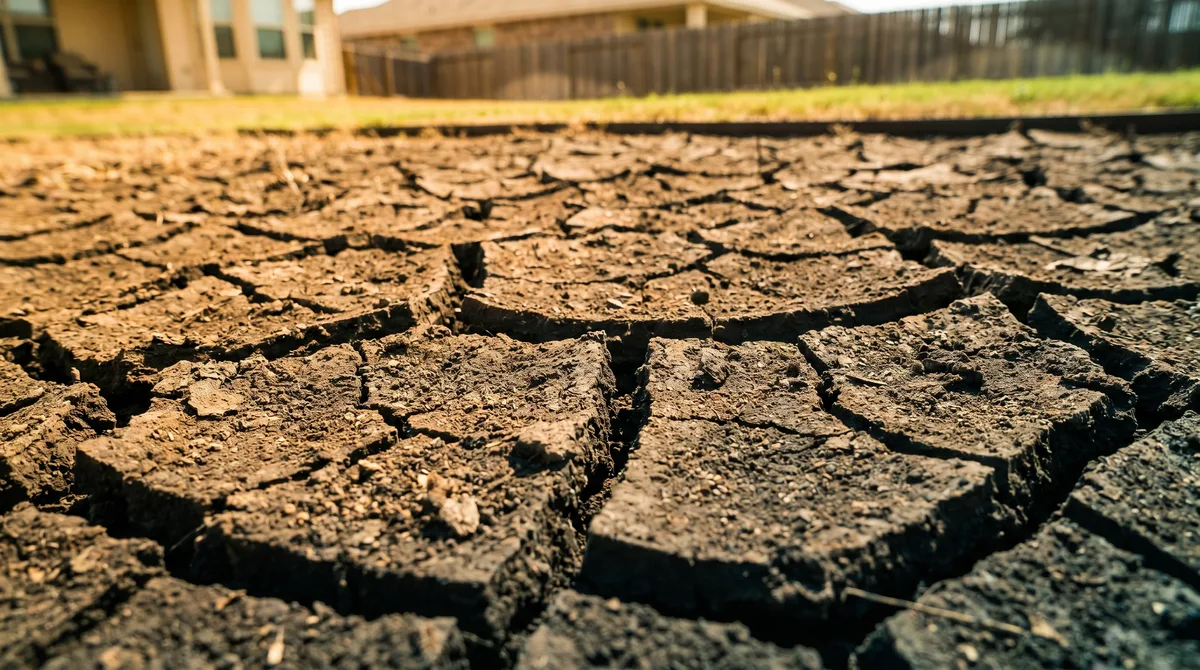
A lot. The Blackland Prairie Vertisols have very high shrink-swell potential (linear extensibility well above the 9% 'very high' threshold), and a slab can rise and fall several inches between a wet spring and a drought summer. You can sometimes see the cracks open in the bare soil itself during a dry August.
What foundation problems does clay soil cause?
Clay soil causes foundation problems by swelling when wet and shrinking when dry, moving a home unevenly. The result is cracks in slabs, drywall, and brick (often stair-step cracks); slab heaving; sticking doors and windows; gaps around door and window frames; sloping or uneven floors; and brick or chimney separation. All of it traces back to differential movement of the soil, not poor construction.
Is my home doomed if it's on clay?
No. Plenty of homes on Blackland clay never need major repair — the key is keeping soil moisture stable so the clay doesn't swing between extremes. That means good drainage, gutters, root management, and consistent watering of the foundation in summer. When movement does occur, it's fixable.
What is Edwards Plateau soil like for foundations?
Edwards Plateau soil — the Hill Country west of the Balcones Fault — is thin and stony, usually only a foot or two deep over Edwards and Glen Rose limestone. Series like Tarrant, Brackett, and Speck are shallow Mollisols, and because slabs there bear on or near competent rock, they move far less than homes on deep Blackland clay. Risk is low to moderate, but valleys with deeper transported clay and lots that straddle the fault are exceptions.
Tell us what you’re seeing and we’ll connect you with one trusted local specialist for a free inspection — no pressure, no spam, no reselling your info.