Repair Methods
Foundation Crack Repair in Austin
The short answer
Foundation crack repair uses epoxy or polyurethane injection to seal cracks in concrete or masonry, stopping water intrusion and restoring structural continuity. It costs $500–$1,500 per crack. Injection fixes the crack itself — not underlying movement. Horizontal, growing, or stair-step cracks usually require settlement repair, not just sealant.
| Repair | Typical Austin range |
|---|---|
| Crack injection (per crack) | $500–$1,500 |
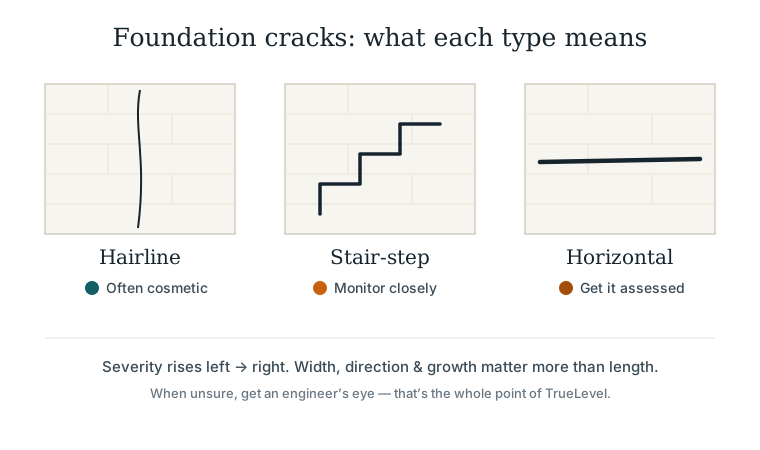

Not all cracks are equal
A crack is a symptom, not a diagnosis. That distinction determines whether a $700 injection job solves your problem or just delays a much larger repair.
Foundation cracks fall into a few categories, and each tells a different story:
Hairline vertical cracks are the most common and least alarming. Concrete shrinks as it cures, and minor shrinkage produces thin vertical lines — typically less than 1/16 inch wide. In a poured concrete wall or slab, these are usually cosmetic.
Diagonal cracks running at roughly 45 degrees often indicate differential settlement — one part of the foundation dropping relative to another. They’re worth monitoring and frequently indicate that the underlying soil movement needs to be addressed alongside the crack itself.
Horizontal cracks in basement or retaining walls are the most structurally serious pattern you can find. They indicate lateral soil pressure bowing the wall inward. Injection will not fix this — the wall needs lateral support.
Stair-step cracks in brick follow the mortar joints in a stepped diagonal pattern. These almost always mean differential settlement beneath the masonry veneer. See the stair-step cracks guide for a detailed breakdown of what drives this pattern in Austin homes.
Wide cracks — anything approaching 1/4 inch — have typically opened due to significant movement, not just normal curing. Width alone is not the whole story, but it’s a flag.
The distinction that matters most: is the crack active (still moving) or stable (done moving)? Mark the ends with a pencil, note the date, and check it in 30 days. If it grows, the foundation is still moving and sealing it is premature. The foundation cracks overview covers more warning signs to track.
Is “approaching 1/4 inch” really the line?
The 1/4-inch figure above is a fast field read, not an engineering standard. The number engineers actually use comes from the American Concrete Institute’s ACI 224R guidance for reinforced concrete in contact with soil and moisture: about 0.012 inch — roughly 1/8 inch — as the upper bound of a “reasonable” crack width under normal service conditions, half the informal threshold above.
The two numbers aren’t contradicting each other; they answer different questions. The 1/4-inch line is a rough “this is probably active movement, not curing” filter. The ACI 1/8-inch figure is a durability threshold — past that width, moisture intrusion and eventual corrosion of embedded steel become a real concern even on a foundation that’s otherwise stable. A crack can clear the “probably not active” 1/4-inch filter and still be past the ACI durability line.
You don’t need a crack gauge for a rough read: a dime’s edge is about 0.05 inch thick, a credit card’s edge about 0.03 inch — if a crack easily swallows a dime, it’s already past the 1/8-inch ACI guidance point. See the concrete crack-width guide for the full ACI 224R breakdown and measuring tips.
Epoxy vs. polyurethane: which injection material is right
Crack injection sounds simple — fill the void, done. But the two primary injection materials work very differently, and using the wrong one for the application undermines the repair.
Epoxy injection cures into a rigid, high-strength bond. A properly cured epoxy repair is often stronger than the surrounding concrete. This makes it the right choice for:
- Dry cracks (moisture prevents adhesion)
- Structural cracks in slabs where load transfer across the crack matters
- Situations where restoring the monolithic strength of the concrete is the goal
Polyurethane foam injection expands as it cures, stays flexible, and creates a watertight seal even in wet or actively seeping cracks. It’s typically the right material for:
- Basement wall cracks with active water infiltration
- Cracks where some ongoing minor movement is expected
- Applications where flexibility matters more than rigid structural bond
Some contractors default to one material regardless of conditions. Ask specifically which material they’re using and why — the answer tells you something about how carefully they’re diagnosing your situation.
The crack repair process
The steps outlined above cover the mechanics, but it’s worth understanding what good execution looks like in practice.
Prep work matters more than the injection itself. Ports placed too far apart, or a crack that hasn’t been thoroughly cleaned, means the material won’t fully penetrate. The injection should fill the crack from back to front — you want the material traveling the full depth of the wall or slab, not just the surface layer.
Pressure matters. Low-pressure injection (the standard for most residential work) lets the material cure in place rather than being forced in too fast to achieve full penetration. High-pressure injection is used in some commercial applications but risks widening the crack.
After injection, the ports are removed and the surface is finished. For structural epoxy repairs on slabs, the area is typically ground smooth. For wall cracks, the finish depends on whether the wall is exposed or will be covered.
The step that separates a legitimate repair from a patch job: addressing the cause. If drainage is saturating the soil against your foundation, or if the grade is sloping toward the house, sealing the crack without fixing those conditions is short-lived. A good contractor will note these issues even if they’re outside the scope of the injection work.
What crack repair costs in Austin
Crack injection itself is relatively affordable. Most residential crack repairs in the Austin area run $500–$1,500 per crack, depending on length, depth, and which material is used. A single hairline crack on an interior wall is at the low end. A long diagonal crack in a poured concrete wall that requires more ports and structural epoxy is at the upper range.
When settlement is involved — when the crack is a symptom of the foundation moving rather than just curing — the cost picture changes substantially. Adding piers to stabilize an actively settling foundation typically runs $3,000–$10,000+ depending on how many piers are needed and the access conditions. The crack injection is then a follow-on step after the foundation is stabilized.
See the full cost guide for a detailed breakdown of what different repair scopes run in Central Texas.
Why Austin’s clay makes cracks more common
Central Texas sits on Blackland Prairie — an expansive clay soil that shrinks dramatically in dry conditions and swells when wet. The volume change is significant, and it happens seasonally (and sometimes week to week during Austin’s boom-bust rain cycles).
A foundation resting on this soil moves. Not always enough to cause structural damage, but enough to stress concrete and open cracks over time. The directional pattern of cracking often reflects the soil movement beneath: one corner drops during a drought, producing diagonal cracks from that corner’s openings. The rains return, the soil re-wets unevenly, and the foundation shifts again.
This is why Austin homeowners see more foundation cracking than counterparts in other regions, and why cracks that seem minor can be worth monitoring even if they don’t need immediate repair. The foundation problems overview covers how Austin’s conditions affect long-term foundation performance.
When crack injection isn’t enough
The principle worth understanding: crack injection repairs the crack, not the foundation. These are not the same thing.
If your foundation is actively settling — soil eroding, clay shrinking unevenly, or a post-tension cable failure — the force causing the crack is still present after you seal it. The sealant holds. Then the foundation moves again and a new crack opens nearby, or the same crack re-opens at a different angle. You have spent money on a symptom while the underlying problem continues.
The scenarios where crack injection is not the right primary repair:
- Horizontal cracks in basement or retaining walls — the wall needs lateral support, not a sealant
- Cracks that are actively growing — measure and mark before any repair; if it’s moving, it needs to be stabilized first
- Multiple cracks appearing across the structure — a pattern of new cracking usually means active movement
- Evidence of differential settlement — sloping floors, sticking doors, gaps at windows — that suggests the foundation needs settlement repair, not just crack sealing
Injection is appropriate when the foundation is stable and the crack represents a completed event, not an ongoing one.
Getting the diagnosis right
The most important decision you’ll make isn’t which injection material to use — it’s whether to inject at all, and who tells you that.
Contractor diagnoses are free, but they’re not neutral. A company that sells crack injection has an incentive to recommend crack injection. That’s not a character flaw — it’s just how business works. The risk is getting a repair that addresses the symptom rather than the underlying condition.
An independent foundation inspection from a licensed structural or geotechnical foundation repair engineer typically costs $400–$850 in the Austin area and gives you a diagnosis with no stake in which repair method you choose. For any crack that isn’t clearly cosmetic — anything horizontal, wide, growing, or part of a pattern — that fee is worth it before committing to a repair approach.
The engineer’s report also gives you documentation that can be valuable if you’re selling the home or dealing with a contractor dispute later.
If you’re ready to get estimates from vetted foundation specialists in Central Texas, get connected here. If you’re still in the assessment phase, the foundation inspection page explains what a professional evaluation covers.
Frequently asked questions
Which cracks are serious?
Horizontal cracks, stair-step cracks in brick or block, cracks wider than about 1/4 inch, and any crack that keeps growing are the ones to worry about — they usually mean active movement. Thin vertical cracks are often just curing or minor settling.
Does crack injection fix my foundation?
It fixes the crack, not necessarily the foundation. If settlement is pushing the foundation around, sealing the crack is a bandage — the movement will open it (or a new one) again. That's why diagnosis comes first.
Is epoxy or polyurethane better for foundation crack repair?
It depends on the goal. Epoxy creates a rigid, structural bond stronger than the surrounding concrete — use it on dry, non-moving cracks where restoring load capacity matters. Polyurethane foam expands, stays flexible, and seals wet or actively seeping cracks. Most contractors use polyurethane on basement walls and water-infiltration cracks, and epoxy on slab cracks where structural continuity is the priority.
Can I repair a foundation crack myself?
DIY injection kits exist for hairline and minor vertical cracks, and they can work for cosmetic sealing. The problem is diagnosis, not application — homeowners routinely seal cracks that are symptoms of active settlement, masking a worsening problem. If the crack is wider than 1/8 inch, diagonal, or has been growing, get a professional assessment before you buy a tube of epoxy.
How long does foundation crack injection last?
On a stable foundation with no ongoing movement, a properly injected crack can hold indefinitely — the repair material often outlasts the surrounding concrete. The failure mode isn't the sealant breaking down; it's the foundation continuing to move and opening a new crack nearby. Address the cause of movement and the repair lasts. Ignore it and you'll be patching again.
How do I know if a foundation crack is serious?
Four signals: direction (horizontal cracks in basement walls are the most urgent), width (anything approaching 1/4 inch deserves evaluation), activity (mark the ends with pencil and date it — if it grows, it's active), and pattern (stair-step cracking in brick follows mortar joints and typically means differential settlement). Any single one of these warrants a professional look before sealing.
Is 1/8 inch or 1/4 inch the real crack-width cutoff?
Both are legitimate, they just answer different questions. The American Concrete Institute's ACI 224R guidance treats about 1/8 inch as the durability threshold for concrete exposed to soil and moisture — past that, corrosion risk becomes a real concern even on a stable foundation. The looser 1/4-inch line used elsewhere on this page is a faster field filter for spotting probable active movement. If you're unsure which applies to your crack, use the more conservative 1/8-inch mark.