Repair Methods
What's the Best Foundation Repair Method? Steel, Concrete & Helical Piers Compared
The short answer
There is no single best foundation repair method — the right pier depends on your soil, load, and budget. On Central Texas clay, pressed concrete pilings ($300–$800/pier) are the economical default, steel push piers ($1,200–$2,500/pier) reach deeper for heavier or badly settled homes, helical piers ($1,500–$3,000/pier) suit lighter structures, and drilled bell-bottom piers ($700–$1,500/pier) are the engineer-favored poured option when cure time isn't a problem.
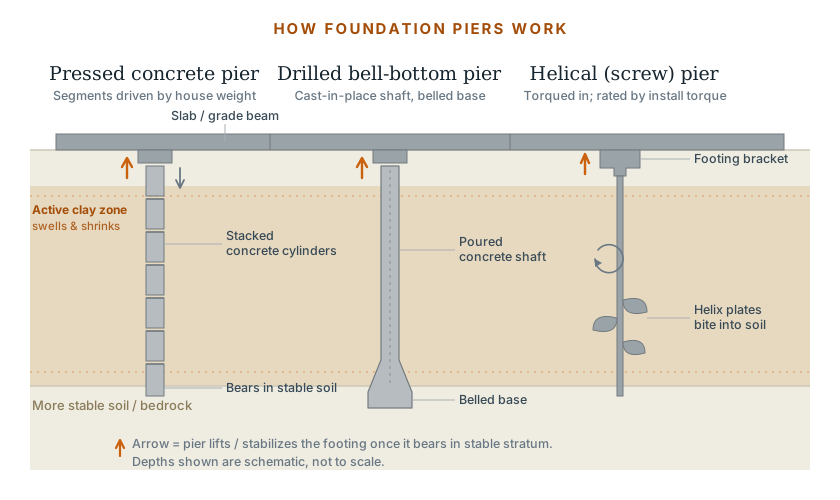

The four piers you’ll actually be quoted in Austin
Every slab underpinning bid you get will be built on one of four pier types. Here’s the honest comparison:
| Pier type | Cost per pier (installed) | Typical depth | Best for | Watch out for |
|---|---|---|---|---|
| Pressed concrete piling | $300–$800 | 8–14 ft (to refusal) | Typical Austin slab homes; budget-conscious repairs | Depth limited by press force; verify it reached refusal, not just resistance |
| Steel push pier | $1,200–$2,500 | 20–60+ ft | Heavy homes, deep unstable soil, badly settled areas | Overkill (and overpriced) for many ordinary jobs |
| Helical pier | $1,500–$3,000 | 10–30 ft (to torque) | Lighter structures, porches, additions, pier & beam | Needs correct helix sizing; torque readings are your proof |
| Bell-bottom (drilled) pier | $700–$1,500 | 9–12 ft + belled footing | Engineer-specified repairs; large bearing area on clay | 7–10 days concrete cure before lifting; messier install |
Each has a full guide: pressed concrete and slab methods, helical piers, and bell-bottom piers.
How to actually choose (the engineer’s logic)
- Soil first. On shallow expansive clay over stiff marl — common along the I-35 corridor — a pressed pile driven to refusal performs well. Where active clay runs deep (parts of East Austin and the Blackland Prairie), piers must get below the moisture-change zone, which favors steel or deeper drilled piers. Check your soil before you compare bids.
- Load second. A two-story brick home concentrates far more load per pier than a one-story frame house. Heavy = steel or bell-bottom; light = helical shines (pressed piles need the home’s weight to install).
- Schedule and access third. Pressed and steel piers lift the same week. Bell-bottom piers need 7–10 days of cure. Tight access (pool decks, additions) favors helical equipment.
- Budget last — but honestly. A $4,500 pressed-pile bid and a $15,000 steel bid for the same eight corners aren’t “cheap vs. good.” They’re different engineering assumptions. Make each company justify the depth their method reaches and what happens if it doesn’t perform.
Push piers vs. helical piers: the head-to-head
These two steel methods get compared constantly, and the difference isn’t just depth — it’s how each one actually goes into the ground.
Push piers are hydraulically driven in sections, using the house’s own dead weight as the reaction force to press the pier down to refusal. That’s the catch: they generally need a heavy enough structure sitting on top to push against, which is why they’re the standard for a loaded slab or brick home but a poor fit for a light addition, porch, or deck that doesn’t weigh enough to drive against.
Helical piers are mechanically torqued — screwed — into the ground with a hydraulic torque motor, independent of the structure’s weight entirely. Installed capacity is estimated from how much torque it took to turn the pier in, not from how hard the house pushed back. That’s why helicals show up on additions, porches, and pier-and-beam work where a push pier can’t get enough reaction force, and why the install produces noticeably less vibration than a driven pier — a real consideration next to an older home or a shared wall.
Timing differs too: unlike a drilled bell-bottom pier, which needs 7–10 days for the concrete footing to cure before it can be loaded, both push and helical piers can typically be loaded and used to lift the same day they’re installed.
The question that cuts through every sales pitch
Ask each bidder: “What confirms your pier reached stable material — and will you put that measurement in writing?” Pressed piles have press pressure and depth; helicals have torque logs; steel piers have drive pressure; bell-bottoms have the drilling log and engineer’s design. A company that documents its proof will also honor its warranty. One that waves the question off is selling you a product, not a repair.
For what a fair total job costs once pier count is factored in, see the Austin cost guide — and if bids disagree wildly, a few hundred dollars for an independent engineer’s opinion is the cheapest insurance in this industry.
Frequently asked questions
What is the best foundation repair method?
The one matched to your soil and structure. For typical Austin slab homes on expansive clay, pressed concrete pilings are the cost-effective standard. Steel push piers win when stable strata is deep or loads are heavy. Helical piers win for lighter structures and additions. Bell-bottom drilled piers win when an engineer wants a large poured bearing footing and the schedule allows concrete cure time. Distrust any company whose answer is always the one method they happen to sell.
What's the cheapest foundation repair method?
Pressed concrete pilings, at roughly $300–$800 per pier installed in the Austin area. They're cheaper because the segments are precast and pressed in with the home's own weight — no drilling rig, no cure time. For many Central Texas slab repairs they're also perfectly adequate, which is why they dominate the market.
Which foundation repair method lasts the longest?
Any properly installed pier that reaches truly stable strata can last the life of the house, and reputable Austin companies back pressed concrete, steel, and helical piers alike with transferable lifetime warranties. Longevity problems usually come from piers that stopped short of stable soil — not from the material. Depth verification matters more than the brochure.
Do engineers prefer steel or concrete piers?
Independent engineers in Texas often spec drilled bell-bottom piers for their large bearing area, or steel piers where depth-to-stable-strata is significant. But many will sign off on pressed concrete pilings for ordinary residential loads on typical clay profiles. The honest pattern: engineers pick by soil report and load, not by loyalty to a material.
Why do Texas companies push pressed concrete piers when national sites recommend steel?
National content is written for the whole country, where deep unstable fill is more common. In Central Texas, the problem is usually shallow expansive clay over stiffer material, so a pressed pile driven to refusal often performs well at a third the cost of steel. That said, on deep-moving East Austin clay, cheap shallow piers are exactly where failures happen — which is why an elevation survey and soil context should drive the call.
How many piers does my house need?
There's no fixed spacing rule — pier count and placement come from a load calculation, not a formula. An engineer or experienced installer works out how much load each section of footing carries, how much the soil and the pier itself can bear, and how much settlement is acceptable, then places piers where the numbers demand it. A single-story frame wall and a two-story brick wall on the same lot can need very different spacing. Treat 'one pier every X feet' as a marketing shortcut, not an engineering answer. That's different from the spacing of a home's original pier grid, which is set by wood beam spans instead — see our pier and beam foundation guide for that distinction.