Repair Methods
Bell-Bottom Piers, Explained
The short answer
A bell-bottom pier is a drilled concrete pier with a footing flared like a bell at the bottom, typically 9–12 feet deep with a base two to three times the shaft width. The bell spreads the home's load across far more soil than a straight pier, which is why independent Texas engineers often spec them on expansive clay. Installed cost in the Austin area runs about $700–$1,500 per pier, and the poured concrete needs 7–10 days to cure before the home can be lifted.
| Repair | Typical Austin range |
|---|---|
| Bell-bottom pier (installed) | $700–$1,500 / pier |
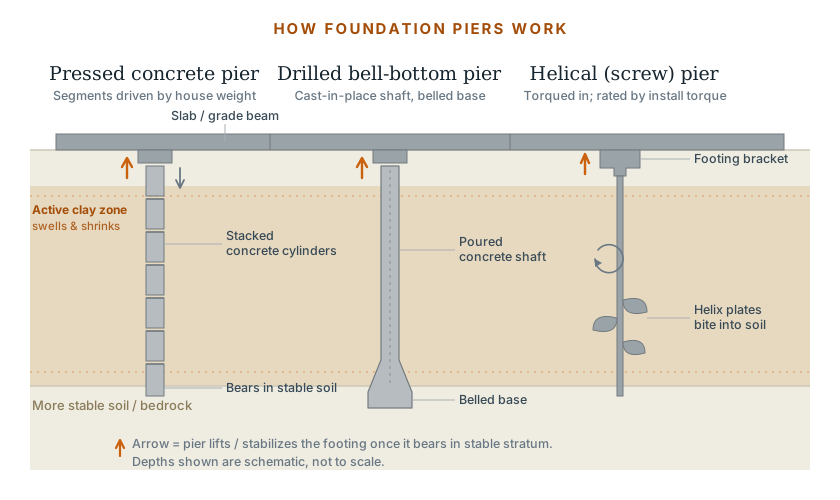

What makes it a “bell” bottom
Picture a concrete column with a trumpet flare at its base. The shaft is drilled 9–12 feet down, then a belling tool carves the bottom of the hole outward into a footing two to three times the shaft’s width. Rebar goes in, concrete is poured, and the result is a one-piece reinforced pier whose load spreads across a wide pad of soil instead of a narrow point.
That geometry is the whole argument. Expansive clay — the stuff under most of Austin — softens when saturated. A wide bell keeps bearing pressure low enough that the pier stays put through wet winters and shrink-crack summers alike.
Where bell-bottoms fit among Austin’s methods
This is the method most associated with independent engineers’ repair plans in Texas: when a structural engineer (not a salesperson) designs a slab underpinning, the drawings frequently call for drilled, belled, reinforced piers. Contractors who lead with pressed concrete pilings aren’t wrong — pressed piles are faster and cheaper and often adequate — but they install with the house’s own weight as the only proof of capacity. A bell-bottom pier’s proof is the drilling log, the design depth, and the visible footing poured to spec.
The fair comparison across all four pier types — pressed, steel, helical, bell-bottom — is in our methods comparison.
Repair method today, new-construction method originally
The drilled, belled footing isn’t a repair-only invention — it’s borrowed straight from new-construction deep foundations, essentially a scaled-down version of the same footing a commercial building bears on, just poured to underpin a house that’s already standing instead of a fresh slab. Central Texas mostly sees it as a repair method because most homes here were built on shallow conventional or post-tensioned slabs, but the same pier design works as original support when a builder’s engineer specs it deep enough from the start.
What if there’s no soil report?
Ideally there’s an engineer’s design behind every bell-bottom pier, sized to a real geotechnical test of your lot. When there isn’t one, the IBC still allows it: a building official can waive the investigation on smaller residential jobs with clearly identifiable soil and size the pier off Table 1806.2’s presumptive bearing values instead — 1,500 psf for clay, up to 12,000 psf for bedrock. Those presumptive numbers are intentionally conservative so they’re safe without site-specific data. That’s the same trade-off our helical pier page covers for steel piles under ICC-ES AC358 — no geotechnical report means a lower, safer design factor, not a smaller pier. A soil report doesn’t just satisfy paperwork; it’s what lets an engineer design tighter to your actual clay instead of the code’s conservative floor.
The two-visit reality
Plan for the job in two acts: drill-and-pour day (one to two days for a typical 10–15 pier layout), then a 7–10 day cure, then lift day, when the crew jacks the slab back within tolerance and shims each pier. If your schedule can’t absorb the cure window — say, a home sale closing in two weeks — that alone may steer the method choice. More on scheduling in how long foundation repair takes.
Frequently asked questions
Why do engineers like bell-bottom piers?
Bearing area. A 10-inch straight pier bears on roughly half a square foot of soil; belling that base to 24–30 inches multiplies the bearing surface several times over, which matters on clay that loses strength when wet. The pier is also poured in place as a single reinforced unit, so there are no segments to shift, and the drilling log documents exactly what soil it sits in.
How much do bell-bottom piers cost?
Around $700–$1,500 per installed pier in the Austin area — more than pressed concrete pilings ($300–$800) but usually less than steel push piers ($1,200–$2,500). A typical job needing 10–15 piers lands in the $8,000–$18,000 range before drainage work.
What's the downside of bell-bottom piers?
Time and mess. The concrete needs 7–10 days to cure before lifting, so the job takes two visits across two weeks, and drilling brings spoil dirt up onto the lawn. Depth is also capped by the drill rig — usually 9–12 feet — so on soils that move deeper than that, steel or helical piers that reach further can be the better call.
Are bell-bottom piers better than pressed concrete pilings?
They're more conservative engineering — bigger footing, one-piece pour, documented depth — and engineers writing independent repair plans in Texas often spec them. But pressed pilings driven to refusal perform well on typical Central Texas profiles at half the price. 'Better' depends on your soil, your budget, and whether an engineer's design is steering the job.
How deep do bell-bottom piers go?
Typically 9 to 12 feet in residential Central Texas work — deep enough to get below the zone where seasonal moisture swings move the clay. That's shallower than steel piers can reach, which is exactly the trade: huge bearing area at moderate depth versus a narrow point driven very deep.
Can bell-bottom piers be designed without a soil report?
Yes, within limits — the IBC lets a building official waive a geotechnical investigation for smaller residential jobs on clearly identifiable soil and size the piers off Table 1806.2's presumptive bearing values instead (1,500 psf for clay up to 12,000 psf for bedrock). Those numbers are deliberately conservative. A real soil report replaces the guess with a tested value for your lot, which is why an independent engineer's design — not a presumptive-value estimate — is worth asking for on a borderline job.
Are bell-bottom piers only used for foundation repair, or new construction too?
Both. The drilled, belled-footing design started as a new-construction deep-foundation method — it's essentially the same engineering as a large commercial footing, just poured under an existing home instead of a fresh slab. On this site we cover it almost entirely as a repair method, since that's the far more common Austin-area use case, but the same pier works as original foundation support when it's engineered deep enough.